
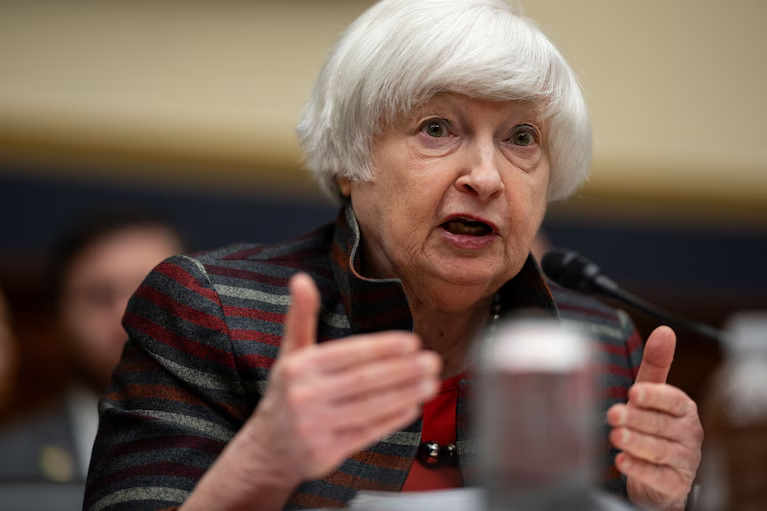


The U.S. government is inching closer to its debt ceiling, prompting a stark warning from Treasury Secretary Janet Yellen about the economic repercussions if Congress fails to act. On Friday, the Treasury Department announced that the government is rapidly running out of funds to meet its debt obligations, setting the stage for a potential financial crisis.
Debt Ceiling Reached
The debt ceiling, a statutory limit on the total amount of money the federal government can borrow to meet its financial commitments, was officially reached earlier this year. Since then, the Treasury has been employing “extraordinary measures” to continue financing the government. However, these measures are nearing their exhaustion point.
“We are running out of time and resources,” Yellen said in a statement. “Failing to address the debt ceiling will have catastrophic consequences for our economy, including the potential loss of millions of jobs and a significant blow to our financial markets.”
Potential Economic Fallout
If the government breaches its borrowing limit, it could default on its debt for the first time in history. Such an event would likely destabilize global financial markets, cause a sharp rise in interest rates, and undermine confidence in the U.S. dollar as the world’s reserve currency.
The government relies on borrowing to fund critical programs, including Social Security, Medicare, military salaries, and interest payments on existing debt. Without an increase or suspension of the debt limit, these programs could face disruptions.
Political Gridlock
Congress has faced repeated showdowns over the debt ceiling in recent years, with debates often split along partisan lines. Republicans have called for reduced government spending as a condition for agreeing to raise the borrowing limit, while Democrats argue that the ceiling must be raised unconditionally to prevent economic turmoil.
House Speaker Mike Johnson has urged bipartisan negotiations to resolve the impasse but noted that Republicans are committed to fiscal responsibility. “We cannot continue to spend at unsustainable levels without addressing the root causes of our debt,” Johnson said.
Treasury’s Urgent Call
Yellen has repeatedly emphasized the importance of swift congressional action, warning that even the mere threat of default could have negative economic consequences. In previous debt-ceiling standoffs, ratings agencies downgraded U.S. creditworthiness, and stock markets experienced significant volatility.
“Increasing the debt limit is not about authorizing new spending; it’s about meeting obligations already made by Congress,” Yellen said. “Delaying action jeopardizes our economic stability and the livelihoods of millions of Americans.”
Deadline Looming
The Treasury has not yet announced the exact date when the government will run out of funds, but analysts predict it could happen within weeks if no action is taken. Lawmakers now face intense pressure to reach an agreement before time runs out.
As the deadline approaches, economists and financial experts are warning that the risks of inaction far outweigh any political gains, urging Congress to prioritize the nation’s economic well-being over partisan disagreements.